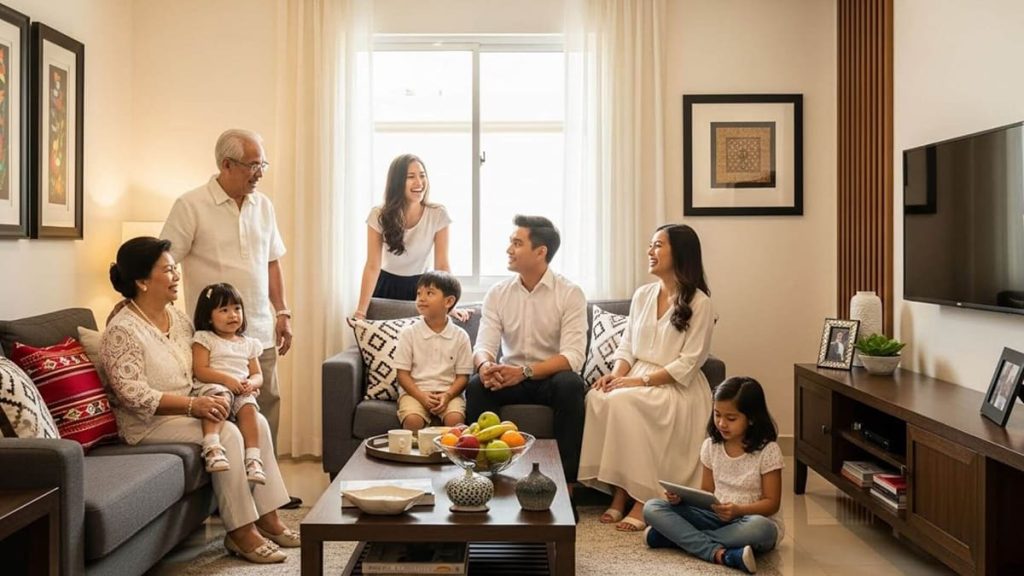


The Truth of How We Live
Home no longer follows one family formula. That may be one of the clearest truths of living today. Design has always evolved because living is never static: the Filipino home has moved from ancestral compounds to subdivisions, from formal receiving rooms to open-plan spaces, from horizontal neighborhoods to vertical urban living. More recently, homes became offices, studios, gyms, and sanctuaries. Now, another quiet shift is entering the floor plan: the way couples build lives together is changing.
Cohabitation is part of this new domestic reality. Philippine Statistics Authority data shows common-law or live-in arrangements among the household population aged 10 and over increased from 9.2 percent in 2015 to 14.7 percent in 2020, with the National Capital Region at 20.1 percent. Registered marriages declined by 10.2 percent in 2024 from the previous year, while average household size fell from 4.1 persons in 2020 to 3.8 in 2024. These numbers do not say family has lost meaning. They show love, partnership, and household formation are being shaped by varied social and economic realities.
For many modern couples, home is not automatically a prelude to marriage or parenthood. It may be a practical step, a chosen partnership, a shared economic decision, or a meaningful commitment that does not follow the old sequence of wedding, children, and family home. The script is no longer singular.

If the truth of living has changed, the truth of housing must change with it. Design does not moralize. It observes how people actually live and gives that dynamic better form.
A relationship-responsive home recognizes that a healthy shared life needs both connection and separation. It needs “ours” spaces: a dining table for rituals, a kitchen for shared habits, a sofa or balcony where two people can pause together. But it must also protect “mine” and “yours”: separate work areas, equal storage, a reading chair, a vanity, a gaming corner, a workout mat, or one wall where each person’s interests can exist.

Privacy should not be treated as distance. It is a form of care. In dense urban homes, especially where hybrid work has made the home an office, screens, shelves, curtains, lighting, furniture orientation and acoustic planning can create psychological boundaries in small units. Good design reduces friction: clear storage, shared drop zones, efficient laundry areas and kitchens planned around actual habits make domestic labor more visible and easier to share.
For designers, developers and homeowners, the task is no longer to design for the average household, but for the actual household: partners with different work rhythms, sleep schedules, hobbies, pets, ambitions and ways of building a future.
The Filipino home has never been frozen in time. It has absorbed migration, urbanization, technology, work, family duty and aspiration. Now, it must also absorb the changing ways people love and live together.

The future of housing is not only smarter technology or better finishes. It is a deeper understanding of the evolution of human life and welcoming design to give it shape.
And if design has always evolved with the times, then perhaps the next evolution of home is this: a space that does not impose an old formula on new lives, but listens closely enough to translate the way people actually live into spaces where they can live better.
#PhilSTARPropertyFeature
#FeaturedStory