

Across Metro Manila and key regional centers, daily movement has become one of the most defining parts of urban life. For many Filipinos, commuting is not just about distance—it is about time spent navigating transfers, traffic, and uncertainty that often take away hours meant for work, family, and rest.
Against this backdrop, Ayala Land continues to embed mobility as a core element of its estate development strategy. Through integrated planning, the company strengthens how people move within and beyond its communities, linking transport systems with walkable environments, mixed-use developments, and connected urban districts.
Estate design that brings destinations closer
Ayala Land’s approach begins at the scale of its masterplanned estates, where residential, commercial, institutional, and recreational spaces are designed to function as interconnected environments. This structure naturally reduces the need for long-distance travel and supports a more efficient, “closer-to-home” way of living.
Beyond proximity, these estates are also linked to wider city networks through transport infrastructure that includes point-to-point (P2P) services, organized terminals, and multi-modal access points designed to simplify daily movement.
Transport hubs shaping everyday commutes
Within its estates, Ayala Land has developed dedicated transport hubs and P2P terminals that support more predictable and streamlined travel experiences across Metro Manila and key provinces.

Makati Central Business District anchors its mobility network through One Ayala Transport Terminal and several P2P routes, allowing commuters to move between business and residential areas with greater consistency while helping reduce reliance on private vehicles.

Circuit Makati integrates transport access points that serve both daily workers and event-goers, supporting mobility needs tied to its mix of offices, retail, and entertainment spaces.
In Quezon City, Vertis North connects to broader metro movement through transport services linked to Trinoma, with its location further strengthened by future rail connectivity between MRT-3 and MRT-7, positioning the estate as a key northern gateway.
In the south, South Park District in Alabang integrates transport facilities within Ayala Malls South Park, supporting intra-city travel within Muntinlupa while maintaining links to other business centers.

Nuvali in Laguna extends this model beyond Metro Manila, with transport connections that link the eco-city to the capital and nearby provinces, supporting residents who balance suburban living with urban employment.

In Cavite, Vermosa incorporates planned mobility infrastructure that improves regional access, making daily travel more direct for both residents and workers within the area.
In the Visayas, Cebu Business Park and Cebu IT Park function as major employment hubs supported by organized transport systems that manage commuter flow and improve access to surrounding commercial and office districts.
Across these locations, transport hubs are designed to address a persistent challenge in Philippine cities: the first and last mile of the commute. By situating mobility access points within walking distance of key destinations, Ayala Land reduces friction in daily travel and improves reliability for commuters.
Walkability as everyday infrastructure
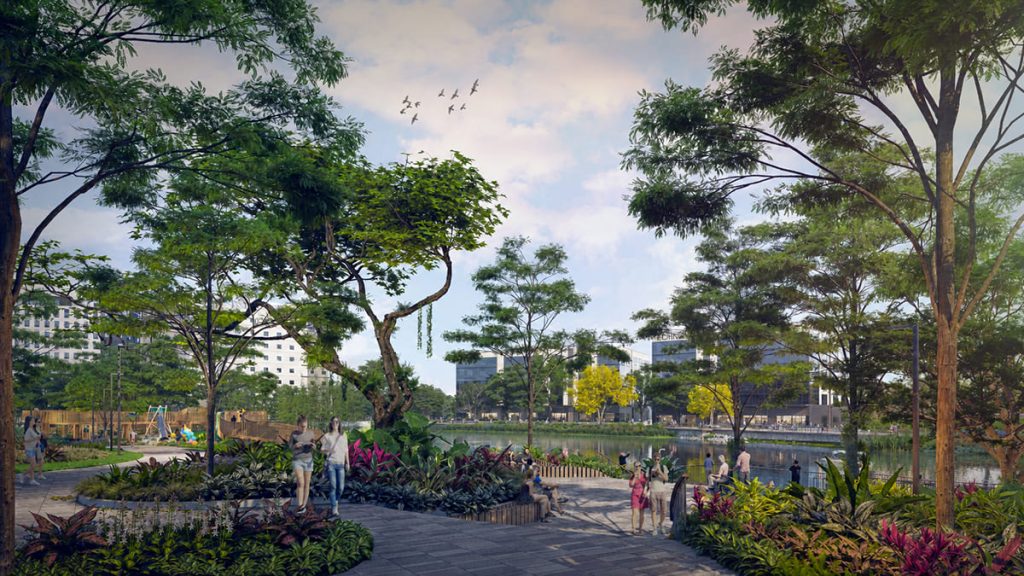
Complementing its transport systems, Ayala Land places strong emphasis on pedestrian-friendly design. Within its estates, wide sidewalks, shaded walkways, safe crossings, and traffic-calmed streets support more comfortable and secure movement on foot.
This approach recognizes the everyday reality of Filipino commuters who rely on walking as part of their daily routines. It also supports seniors, students, and workers by making pedestrian travel not only possible, but practical and consistent.
Bike-friendly elements further expand mobility options, encouraging shorter, more sustainable trips within estates and reinforcing a more active urban lifestyle.
Mobility that supports livelihoods and access
Improved connectivity within Ayala Land estates also plays a role in expanding access to opportunities. Integrated transport systems help link residents to employment centers, schools, and essential services with greater ease.
At the same time, these mobility networks sustain local economic activity within estates, supporting retail workers, service providers, transport operators, and small businesses that rely on consistent foot traffic generated by organized urban environments.
Advancing sustainability through movement

Ayala Land’s mobility framework also contributes to broader environmental goals. By encouraging public transport use, walking, and cycling, its estates help reduce congestion and lower carbon emissions in urban areas.
Developments such as Nuvali, Vertis North, and Vermosa also help decentralize growth by distributing economic activity across regions, easing pressure on Metro Manila while strengthening urban resilience in surrounding provinces.
Reframing the everyday commute
Ultimately, Ayala Land’s mobility ecosystem is designed around everyday experience. Whether it is a shorter walk to a transport hub, a more predictable ride to work, or a safer path through the estate, these systems aim to make daily movement less burdensome and more efficient.
By connecting places, systems, and people through integrated design, Ayala Land reframes mobility not as a challenge to endure, but as an essential part of a more livable urban future.
#PropertyPR
#MediaRelease